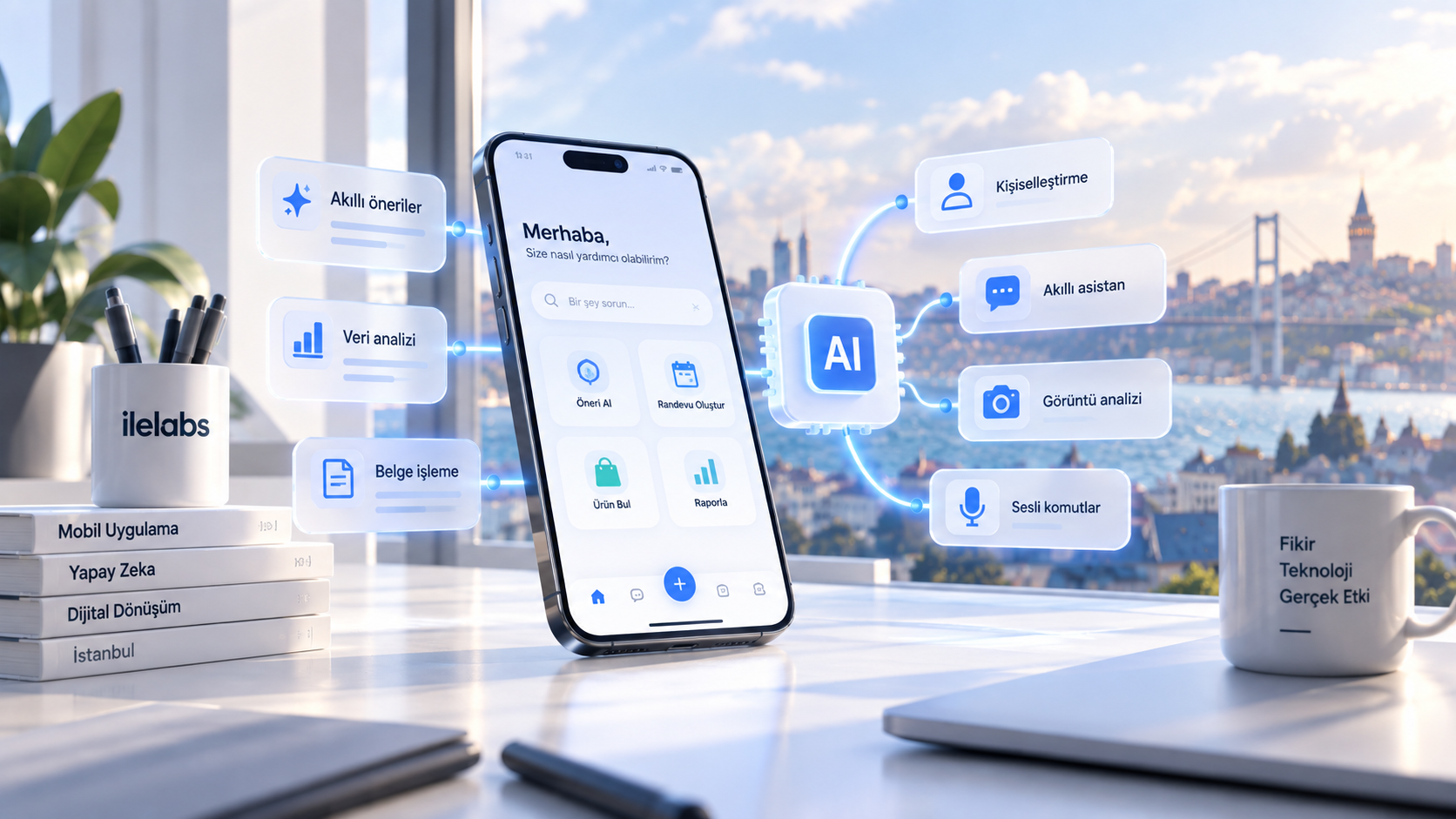
Artificial intelligence is now easier to integrate into mobile applications than ever before.
That does not mean every mobile app should use AI.
The real question is not:
“Can we add AI to our mobile app?”
The real question is:
“Which user problem can AI solve better, faster, or more efficiently?”
Today, businesses can quickly add AI-powered chat, smart search, content generation, image analysis, voice interaction, recommendation systems, and many other features to mobile applications.
However, if these features do not solve a real problem, they can increase development costs, create unnecessary complexity, and make the product harder to use.
For businesses in Istanbul planning to build a mobile app with artificial intelligence, the most important step is to understand where AI actually creates value.
This guide explains the most useful AI applications in mobile software, how the technical architecture should be planned, and what businesses should consider before starting development.
Start With the User Problem, Not the Technology
Many mobile app projects begin with a list of features.
The conversation often sounds like this:
Users should be able to register.
We need push notifications.
There should be online payment.
We need maps.
We should also add artificial intelligence.
This approach usually leads to unnecessary features.
The better approach is to start with the user's problem.
Ask:
Why will someone open this application?
In a healthcare application, the user's main problem may be finding the right service and booking an appointment.
In an e-commerce application, the problem may be choosing the right product among hundreds or thousands of options.
In an education application, the problem may be understanding what the student does not know and what they should study next.
Artificial intelligence should only be included if it can improve one of these processes.
AI should not be the purpose of the product.
It should be a tool that makes the product more useful.
1. Personalized Recommendations
One of the strongest use cases for AI in mobile applications is personalization.
Traditional mobile apps often show the same products, content, or services to every user.
AI-powered systems can analyze user behavior and create a more personalized experience.
This may include:
previous purchases,
search history,
application usage,
user preferences,
interaction history,
saved items,
location-based behavior where appropriate.
For example, an e-commerce app can recommend products based on the user's interests.
An education platform can suggest the next lesson or practice test.
A healthcare platform can guide users toward relevant services.
A travel application can recommend destinations or activities based on previous preferences.
The purpose is not simply to say that the application uses artificial intelligence.
The purpose is to reduce the amount of time the user spends searching and deciding.
2. Natural Language Search
Traditional search systems depend heavily on keywords.
Users must often know exactly what to type.
Artificial intelligence can make search much more natural.
Instead of searching for:
“family restaurant Istanbul”
a user might write:
“I’m looking for a quiet place in Istanbul where I can go with my children this weekend.”
An AI-powered search system can understand the meaning behind the request instead of matching only individual words.
This can be useful in many industries, including:
e-commerce,
real estate,
healthcare,
education,
tourism,
marketplaces,
local service platforms,
corporate software.
For applications with large amounts of content, products, or service listings, intelligent search can significantly improve the user experience.
3. AI Assistants Inside Mobile Applications
A chatbot and an AI assistant are not necessarily the same thing.
A simple chatbot usually responds to predefined questions.
A properly integrated AI assistant can work with application data and perform more useful tasks.
For example, a user could ask:
“Which of my orders from last month have not been delivered yet?”
The AI assistant could check the user's order history and return the relevant information.
In a business application, a manager could ask:
“Why did our sales in Istanbul decrease this month?”
If the system has access to the correct business data, it can analyze the information and provide an explanation.
This is where AI starts becoming part of the actual software product rather than just an additional chat screen.
4. Image and Visual Analysis
Artificial intelligence is not limited to text.
When combined with smartphone cameras, AI can create many practical mobile application features.
Examples include:
Retail:
Identifying products or product categories from images.
Real Estate:
Classifying rooms, objects, or property features from listing photos.
Manufacturing:
Detecting visible defects, damage, or irregularities.
Field Operations:
Analyzing photos uploaded by employees and checking whether certain tasks have been completed correctly.
Healthcare:
Supporting authorized healthcare professionals with image-based analysis and decision support systems.
In sensitive industries such as healthcare, AI should usually support professional decision-making rather than replace it.
The same principle applies to finance, legal services, and other high-risk areas.
5. Voice-Powered Mobile Applications
Voice interaction is becoming increasingly important in mobile software.
Users may prefer speaking instead of typing, especially when they are:
driving,
working in the field,
moving between locations,
using the application with one hand,
performing repetitive tasks.
A user might say:
“Show me my last customer order.”
“What appointments do I have today?”
“Summarize this meeting.”
“Create a note from this conversation.”
Voice functionality can be especially valuable for sales teams, field employees, managers, healthcare professionals, and operational teams.
The key is to use voice where it creates convenience rather than adding it as a decorative feature.
6. Document Processing
Document processing is another area where artificial intelligence can create significant value.
A mobile application may allow users to upload:
invoices,
contracts,
quotations,
reports,
forms,
receipts,
certificates,
business documents.
AI can extract useful information from these files.
For example, when an invoice is uploaded, the system may automatically identify:
company name,
invoice amount,
date,
category,
tax information,
related project,
customer or supplier.
The real value is not simply reading the text.
The value comes from connecting the extracted information to the rest of the software.
For example, the application could automatically create an accounting record, attach the document to a project, or notify the relevant employee.
At this point, AI becomes part of the operational workflow.
Does Every Mobile App Need Artificial Intelligence?
No.
Many mobile applications do not need AI.
If the user only needs to:
book an appointment,
check a balance,
place an order,
view information,
submit a form,
track a delivery,
traditional software development may be more efficient.
Before adding AI to a mobile app, businesses should ask three questions:
1. Is there a repetitive or time-consuming task?
2. Does the application process large amounts of text, images, data, or user behavior?
3. Can artificial intelligence improve this process in a measurable way?
If the answer to all three questions is no, AI may not be necessary.
Using artificial intelligence simply because it is popular often leads to unnecessary development costs.
Data Is One of the Most Important Parts of an AI Project
A company does not automatically have an AI product just because it adds a ChatGPT-style interface.
In many projects, the real value comes from the company's own data.
This may include:
products,
prices,
customer records,
documents,
service information,
internal procedures,
transaction history,
support content,
operational data.
The AI system needs to understand which data it is allowed to access.
It is equally important to determine which data it must not access.
For this reason, AI-powered software should be designed with:
access control,
user permissions,
data security,
logging,
authorization rules,
data isolation,
privacy requirements.
These topics should be planned before development begins.
Mobile App, Backend, Admin Panel, and AI Should Be Designed Together
An AI-powered mobile application is not only the screen that the user sees on their phone.
A complete system usually includes several layers.
Mobile Application
The iOS and Android interface used by customers or employees.
Backend / API
The infrastructure that manages users, business logic, transactions, and application data.
Admin Panel
The system where the business manages users, content, products, reports, settings, and operations.
AI Layer
The artificial intelligence services that power features such as:
recommendation systems,
language models,
intelligent search,
image analysis,
voice features,
document processing.
Integrations
The software may also connect to:
payment providers,
CRM systems,
ERP software,
e-mail services,
WhatsApp,
SMS providers,
accounting software,
third-party APIs.
If these systems are developed independently without a clear architecture, integration problems may appear later.
For this reason, the technical architecture should be planned before the development process begins.
What Should You Ask a Mobile App Development Company in Istanbul?
There are many mobile app agencies, software companies, and freelance development teams in Istanbul.
The quality of the project should not be evaluated only by looking at the visual design.
For an AI-powered project, businesses should ask important technical and commercial questions before signing a contract.
For example:
Who will develop the backend?
Will there be an admin panel?
Will the source code be delivered?
Which AI model or infrastructure will be used?
How will AI usage costs be calculated?
How will company and customer data be protected?
Will the system scale if the number of users increases?
Is App Store and Google Play publishing included?
Who will manage third-party integrations?
How will the system be monitored after launch?
What happens if the AI provider changes its pricing?
Can the AI infrastructure be changed later?
Is there a plan for maintenance and future development?
A professional software team should be able to answer these questions before development starts.
Start With One Measurable AI Feature
A new application does not need to be completely built around artificial intelligence.
In many cases, the safest approach is to choose one problem and solve it well.
For example:
E-commerce:
Start with intelligent product search.
Education:
Start with personalized question recommendations.
Healthcare:
Start with a patient guidance assistant.
Corporate Software:
Start with document search and summarization.
Marketplace:
Start with intelligent service matching.
Sales Software:
Start with an AI assistant that analyzes customer data.
The first feature can then be tested with real users.
Businesses can measure:
usage frequency,
user satisfaction,
task completion time,
conversion rate,
support requests,
operational savings.
If the feature creates measurable value, additional AI features can be developed later.
This approach reduces both technical risk and development cost.
AI Development Costs Should Be Considered Early
One of the most overlooked topics in AI-powered mobile app projects is ongoing usage cost.
Traditional software usually has server, hosting, maintenance, and infrastructure expenses.
AI applications may have additional costs based on:
number of requests,
text volume,
image processing,
voice usage,
model selection,
data storage,
vector databases,
third-party APIs.
For example, an AI assistant used by 100 users may have a very different monthly cost from the same system used by 100,000 users.
For this reason, businesses should not only ask:
“How much will the application cost to develop?”
They should also ask:
“How much will the application cost to operate when usage increases?”
A well-designed architecture should consider both development costs and long-term operational costs.
Should You Use an Existing AI Model or Build Your Own?
Most businesses do not need to build their own large language model from scratch.
In many projects, it is more practical to use existing AI models through APIs.
These models can then be connected to the company's own software and data.
The important part is the layer built around the model.
This includes:
business rules,
security,
data access,
prompts,
user permissions,
validation,
logging,
workflow automation.
The AI model is only one part of the system.
The real product is the complete software infrastructure that makes the AI useful for the business.
AI Should Not Have Unlimited Access
Giving an AI assistant access to every company record is usually a bad idea.
Different users should have different permissions.
For example:
A customer should only be able to access their own orders.
A sales employee may be able to access customer information related to their department.
A manager may have broader reporting permissions.
An administrator may have access to system-wide settings.
The AI assistant must respect these same access rules.
This is one of the most important technical requirements in enterprise AI development.
Think About the User Experience
AI features should make the application simpler, not more confusing.
A user should clearly understand:
what the AI can do,
what information it is using,
whether the result is a recommendation or a final decision,
how to correct an incorrect result.
AI should not replace every button, menu, and navigation structure.
Sometimes a traditional interface is faster.
For example, pressing a button to book an appointment may be more efficient than asking an AI assistant to do it.
The best applications combine traditional user experience with AI where it is genuinely useful.
AI-Powered Mobile App Development in Istanbul
Istanbul has one of the largest technology and startup ecosystems in Türkiye.
Companies operating in industries such as:
e-commerce,
healthcare,
education,
tourism,
logistics,
retail,
finance,
real estate,
manufacturing,
professional services
are increasingly exploring mobile applications and AI-powered software.
However, building an effective AI product requires more than connecting an application to an AI API.
The mobile application, backend infrastructure, business logic, data architecture, security, integrations, and artificial intelligence layer must work together.
This is why businesses looking for a mobile app development company in Istanbul should focus on technical planning and product strategy as much as visual design.
Conclusion: Add AI to the Problem, Not to the Application
Artificial intelligence is becoming easier to integrate into mobile applications.
But there is still a major difference between a product that simply uses an AI API and a genuinely useful AI-powered software system.
Successful projects usually begin with a clear user problem.
The technical architecture is then designed around that problem.
The data structure, permissions, security, mobile experience, backend, and integrations are planned together.
Artificial intelligence is added only where it creates real value.
At ilelabs, we approach mobile app development, custom software, and artificial intelligence projects as complete digital products rather than a collection of screens.
For businesses planning an AI-powered mobile application in Istanbul, the first question should not necessarily be:
“Which AI technology should we use?”
A better question is:
“What problem are we solving, and can artificial intelligence solve it better?”